
By: Lawrence Harte
The Rise of the Connected Vehicle Digital Services Economy
The automotive industry is rapidly transforming from a hardware manufacturing business into a long-term digital services economy. Vehicle manufacturers, software platform providers, cloud service companies, app developers, advertisers, and mobility operators are increasingly viewing connected vehicles as recurring revenue platforms capable of generating profits for many years after the initial vehicle sale. Connected vehicle technologies now support subscription services, software feature activation, in-vehicle media, app ecosystems, advertising platforms, telematics, mobility services, and data monetization opportunities that are reshaping automotive business models worldwide.
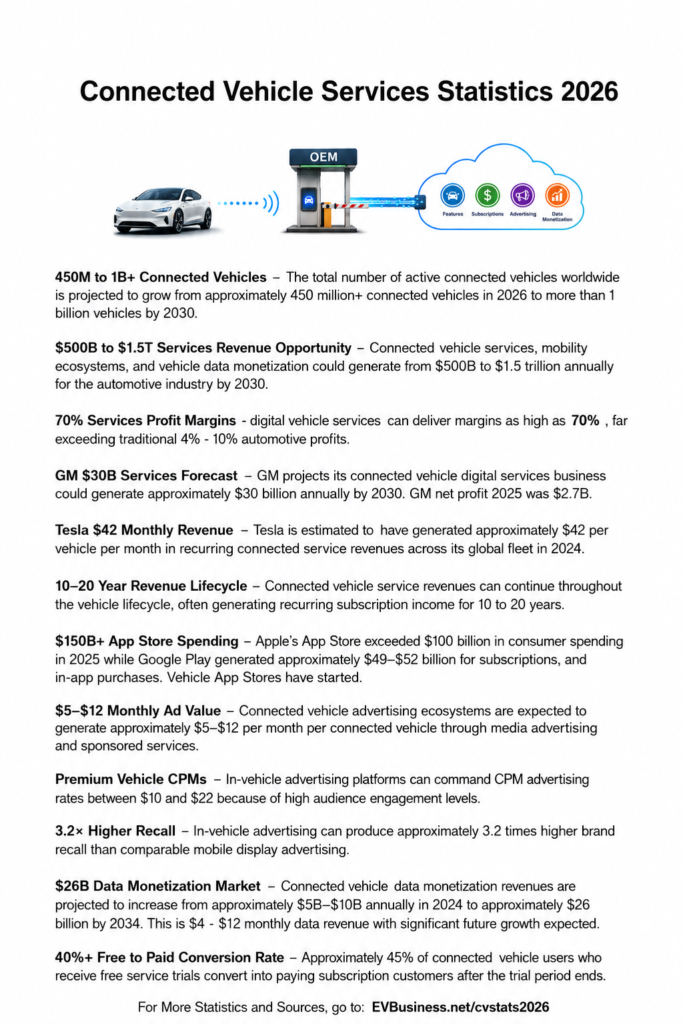
One of the most important statistics driving this transformation is the explosive growth of connected vehicles globally. Industry projections estimate that the number of active connected vehicles worldwide could grow from approximately 450 million connected vehicles in 2026 to more than 1 billion connected vehicles by 2030. This rapid expansion is creating one of the world’s largest digital device ecosystems. Unlike traditional consumer electronics, connected vehicles remain active for 10 to 20 years, allowing manufacturers and service providers to generate recurring revenues throughout the lifecycle of the vehicle.
Why Automotive Companies Are Prioritizing Digital Services
The financial opportunity associated with connected vehicle digital services is enormous. Industry forecasts estimate that connected vehicle services, vehicle app ecosystems, mobility platforms, and data monetization could generate between $500 billion and $1.5 trillion annually for the automotive industry by 2030. These revenues include subscription services, paid software features, app store transactions, media streaming services, advertising, telematics, fleet management, insurance analytics, charging services, and vehicle data monetization.
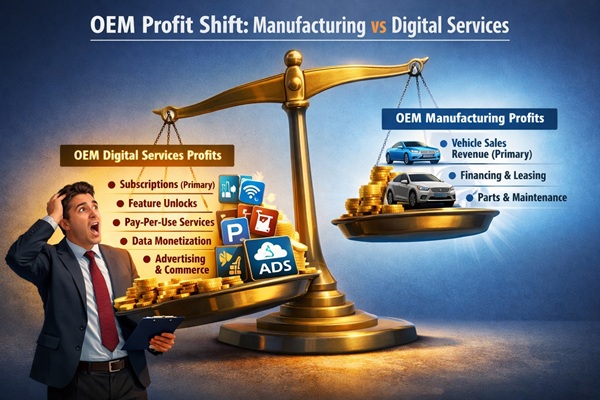
A major reason automotive companies are aggressively pursuing connected services is profitability. Traditional automotive manufacturing businesses typically generate profit margins ranging from approximately 4% to 10%. In contrast, digital vehicle services can deliver margins approaching 70%, similar to the economics of software and cloud platform businesses. This dramatic difference in profitability is changing the strategic priorities of automotive manufacturers and suppliers around the world.
The OEM Race for Digital Revenue
Almost all OEM vehicle manufacturers are developing and providing digital services to keep competitive – and profitable – in a highly competitive global marketplace. General Motors has publicly stated that its connected vehicle and digital services business could generate approximately $30 billion annually by 2030. To put this into perspective, GM’s reported net profit in 2025 was approximately $2.7 billion. This means connected services could potentially generate substantially more annual revenue than some traditional automotive profit centers. Similar strategies are being pursued by many global vehicle manufacturers who are expanding software-defined vehicle initiatives, subscription services, and digital ecosystems.
Automotive companies increasingly recognize that recurring service revenues can provide greater long-term financial stability compared to traditional vehicle sales cycles. As more vehicles become software-defined and connected to cloud platforms, manufacturers are expected to continuously introduce new digital services and premium software upgrades throughout the ownership lifecycle.
Subscription Services and Recurring Revenue Models
Connected vehicle subscription services are becoming one of the most important recurring revenue opportunities for automotive companies. Vehicle owners increasingly pay monthly or annual fees for services such as navigation, premium connectivity, driver assistance systems, entertainment services, remote vehicle management, security services, charging optimization, and fleet management tools.
Tesla has become one of the most visible examples of connected vehicle recurring revenue success. Industry estimates suggest Tesla generated approximately $42 per vehicle per month in recurring connected service revenues across its global fleet during 2024. These revenues come from services such as premium connectivity, Full Self-Driving capabilities, software upgrades, entertainment services, and digital platform features. As vehicle manufacturers continue adding more software-based capabilities, recurring monthly revenues per vehicle are expected to increase significantly across the industry.
The 10–20 Year Connected Vehicle Revenue Lifecycle
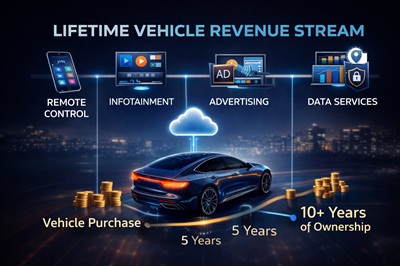
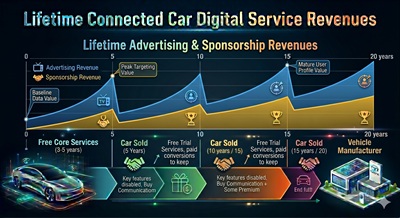
One of the biggest advantages of connected vehicle services is the extended revenue lifecycle. Unlike traditional vehicle sales that primarily generate revenue at the time of purchase, connected vehicle services can continue generating recurring revenues for 10 to 20 years throughout the operational life of the vehicle. This creates long-term customer relationships and ongoing monetization opportunities that were previously unavailable to automotive manufacturers.
This long lifecycle allows vehicle manufacturers to evolve features and services over time through over-the-air software updates, cloud-connected applications, and subscription feature upgrades. Automotive companies are increasingly positioning vehicles as long-term digital service platforms rather than one-time hardware transactions.
Vehicle App Stores Are Beginning to Emerge
Vehicle app stores are also beginning to emerge as important digital ecosystems. The success of mobile app stores provides a strong model for automotive platforms. Apple’s App Store exceeded $100 billion in consumer spending during 2025, while Google Play generated approximately $49 billion to $52 billion through subscriptions, in-app purchases, and digital transactions. Automotive companies are now attempting to replicate portions of this ecosystem inside vehicles by offering downloadable apps, premium services, entertainment systems, navigation tools, charging applications, and vehicle-specific digital features.
The economics of app ecosystems are particularly attractive because platform owners often receive ongoing commissions from digital transactions. Automotive manufacturers increasingly view vehicle operating systems and app ecosystems as future profit centers that can generate recurring revenues while strengthening customer engagement and brand loyalty.
Free Trial Conversion Rates Show Strong Consumer Interest
Free trial conversion rates are another important indicator supporting connected vehicle service growth. Industry studies suggest that more than 40% of users who receive free connected service trials convert into paying subscription customers after trial periods end. Some estimates place this conversion rate at approximately 45%, demonstrating that consumers increasingly recognize value in connected vehicle services and are willing to pay for premium digital experiences.
Automotive manufacturers frequently provide free service trial periods for premium navigation, advanced driver assistance, streaming services, remote monitoring, or charging optimization systems. These trial experiences help consumers become dependent on digital services that improve convenience, entertainment, safety, and vehicle performance.
In-Vehicle Advertising Is Becoming a New Media Platform
In-vehicle advertising is emerging as a major new revenue category for connected vehicle ecosystems. Modern connected vehicles increasingly contain multiple digital displays, infotainment systems, rear-seat entertainment platforms, streaming media services, passenger displays, and voice-enabled interfaces that can support advertising and sponsored services.
Industry estimates suggest connected vehicle advertising ecosystems could generate approximately $5 to $12 per month per connected vehicle through advertising, sponsorships, promotions, and media partnerships. When multiplied across hundreds of millions of connected vehicles globally, this creates an extremely large long-term advertising opportunity for automotive manufacturers, media companies, advertisers, and streaming service providers.
Premium Advertising Rates and Higher Audience Engagement
Advertising inside connected vehicles may also command premium pricing. Industry estimates indicate that in-vehicle advertising platforms could achieve CPM advertising rates between $10 and $22 due to higher audience engagement levels and the highly personalized nature of vehicle environments. Connected vehicles can potentially provide advertisers with contextual targeting capabilities based on location, travel patterns, user preferences, charging behaviors, media usage, and trip characteristics.
Research also suggests that in-vehicle advertising may generate significantly higher effectiveness than traditional mobile advertising. Some studies estimate that in-vehicle advertising can produce approximately 3.2 times higher brand recall compared to comparable mobile display advertising. Higher engagement levels are driven by immersive vehicle environments, large digital displays, premium audio systems, and longer user session durations during travel.
Connected Vehicle Data Monetization Opportunities
Connected vehicle data monetization represents another rapidly expanding business opportunity. Vehicles generate enormous amounts of operational, diagnostic, behavioral, environmental, and mobility data that can be analyzed and monetized for numerous applications. Industry forecasts project connected vehicle data monetization revenues could increase from approximately $5 billion to $10 billion annually in 2024 to approximately $26 billion annually by 2034.
Vehicle data can support applications such as predictive maintenance, insurance analytics, traffic optimization, smart city systems, charging infrastructure planning, fleet management, mapping services, mobility analytics, and targeted advertising. Current estimates suggest connected vehicle data revenues may already generate approximately $4 to $12 monthly revenue per connected vehicle, with substantial future growth expected as data ecosystems mature.
The Automotive Industry Is Becoming a Digital Platform Business
As connected vehicle platforms continue evolving, the automotive industry is increasingly becoming a hybrid of transportation, software, cloud computing, media, advertising, and data services. Vehicle manufacturers that successfully develop digital ecosystems, subscription platforms, app stores, advertising systems, and data monetization capabilities may gain significant long-term competitive advantages in the rapidly changing mobility economy.
Connected vehicles are no longer simply transportation products. They are becoming continuously connected digital platforms capable of generating recurring revenues, delivering personalized experiences, supporting media ecosystems, and enabling entirely new business models across the automotive industry.
References:
- Apple App Store Newsroom
- ARK Invest – Tesla Recurring Revenue Estimates
- BCG – Software Defined Vehicle and Mobility Revenue Forecasts
- Business of Apps – App Store Revenue Statistics
- Capgemini – Connected Vehicle Data Economy Reports
- Connected Vehicle Trade Association (CVTA)
- Deloitte – Future Automotive Software Economics
- Deloitte Global Automotive Consumer Study
- DTS AutoStage and In-Cabin Experience Research
- eMarketer – Digital Advertising CPM Benchmarks
- EV Business Connected Vehicle Statistics 2026
- GM Investor Presentations and Earnings Reports
- IoT Analytics – Connected Car Forecast Reports
- Market.us – In-Car Advertising Market Forecast
- MarketsandMarkets – Automotive Data Monetization Market
- McKinsey – Automotive Software and Digital Services Opportunity
- McKinsey – Automotive Software Margins vs Manufacturing Margins
- McKinsey – Monetizing Car Data
- McKinsey & Company – Connected Car Growth Forecasts
- Nielsen – Advertising Recall and Audience Engagement Studies
- PwC – Automotive Digital Services Market Analysis
- Quu Inc. – In-Vehicle Visuals Report
- Reuters – GM Connected Services Revenue Strategy
- S&P Global Mobility – Connected Vehicle Consumer Studies
- Statista – Connected Car Market Statistics
- Statista – Google Play Revenue Statistics
- Tesla Annual Reports and Shareholder Information

About Lawrence Harte
Lawrence Harte is the publisher and senior editor of EV Business Magazine and the Director of Automotive Media and Digital Services at the Connected Vehicle Trade Association – CVTA. He has authored more than 153 books – mostly on communications, media, automotive and business. Between 2005 and 2026, he interviewed more than 4,137 executives and technologists in the communication, media and automotive industries. He is the author of Connected EVs Explained, EV Charging Systems for Apartments and Connected Vehicle Services Business books. Mr. Harte has worked for Ericsson/General Electric, Audiovox/Toshiba and has been an expert consultant for Samsung, Google TV, Nokia, and dozens of other top media and technology companies. At Ericsson GE, he was responsible for the development of mobile phone radio modules and worked with Ford, Delphi and other companies to help integrate cellular modems – telematics – into vehicles and systems. He holds many degrees and certificates including an Executive MBA from Wake Forest University, and a BSET from the University of the State of New York.