
By: Lawrence Harte
The automotive media industries are undergoing a major transformation as the ways content is delivered, consumed, and monetized inside vehicles rapidly evolve. In 2026, AM/FM radio accounted for 55% of all in-car audio listening and is declining while streaming audio represented 16% and continues to grow. Like the television industry, automotive media is transitioning from traditional channel-based programming to on-demand streaming content. At the same time, connected vehicle displays, touchscreens, voice assistants, and other interactive technologies are creating new opportunities for highly targeted advertising, commerce, and customer engagement. Looking further ahead, autonomous driving technologies will fundamentally change how occupants consume media by increasing opportunities for video, gaming, productivity, and immersive digital experiences during travel. This article covers the key trends driving the automotive media transition and how vehicle manufacturers, media providers, advertisers, and technology companies can prepare for the next generation of connected vehicle entertainment, engagement, and revenue opportunities.
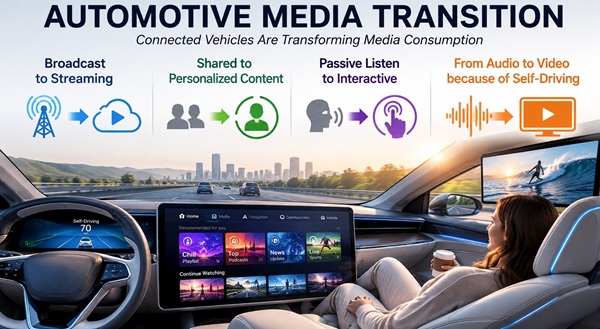
Automotive media is transitioning from broadcast to streaming, from channel-based experiences to AI-driven personalization, from passive consumption to interactive engagement, and from audio-only experiences to increasingly visual media environments. Connected vehicles are rapidly becoming digital media platforms capable of delivering entertainment, information, communications, commerce, and advertising services throughout the vehicle lifecycle.
Broadcast to Streaming Media
For decades, automotive media primarily consisted of AM/FM radio and, later, satellite radio. Vehicle occupants selected channels, listened to scheduled programming, and consumed media determined by broadcasters. While radio remains highly popular, the connected vehicle is increasingly becoming another endpoint for internet-delivered content.
Streaming media services such as music platforms, podcasts, audiobooks, internet radio, and live sports content are rapidly replacing traditional broadcast consumption patterns. Consumers increasingly expect the same on-demand experiences in their vehicles that they receive on smartphones, smart TVs, and tablets. According to Nielsen’s Gracenote automotive research, 40% of vehicle owners report streaming more content in their vehicles than they did a year earlier, while 75% prefer using integrated in-dash systems instead of smartphone mirroring when the experience is compelling.
The rise of streaming is also expanding the range of available content. Instead of choosing between a limited number of local radio stations, vehicle occupants can access millions of songs, hundreds of thousands of podcasts, live sporting events, global news sources, and personalized content libraries. Media metadata providers such as Gracenote now support entertainment experiences across more than 250 million vehicles globally, illustrating the scale of automotive media adoption.
This transition mirrors what occurred in television as viewers moved from broadcast television to streaming video platforms. In automotive environments, streaming media provides greater content choice, enhanced personalization, improved analytics, and new monetization opportunities through subscriptions, advertising, referrals, and commerce services.
Radio Channels and Brands to Personalized Experiences
Traditional media was largely organized around channels and brands. Consumers selected radio stations, television channels, or specific publishers. The connected vehicle is increasingly shifting media discovery away from channel selection and toward recommendation engines and personalized content experiences.
Modern automotive media platforms utilize cloud services, user profiles, artificial intelligence, listening history, viewing preferences, and contextual data to recommend content. Rather than asking “Which station do you want?” systems increasingly ask “What do you want to hear right now?” or automatically recommend content based on user behavior.
This trend is already visible across music streaming services, podcast platforms, and video services. Recommendation engines help users discover new content while increasing engagement and retention. Vehicle manufacturers recognize the value of personalization because it strengthens customer relationships and increases the use of embedded infotainment systems. According to a recent Gracenote automotive study, 94% of consumers surveyed across the United States, Germany, Japan, and South Korea said they would consider switching from smartphone-based entertainment to native in-dash infotainment systems if the available offerings were improved.
Artificial intelligence is accelerating this transition. AI assistants can understand context, location, time of day, vehicle occupancy, destination, and user preferences to deliver highly relevant content recommendations. A driver commuting to work may receive traffic updates and business podcasts, while passengers on a road trip may receive entertainment recommendations tailored to their interests. The future automotive media experience will increasingly resemble having a personalized media concierge embedded within the vehicle.
Passive Consumption to Interactive Experiences
Traditional automotive media was primarily passive. Drivers and passengers listened to radio programs or consumed pre-selected content with minimal interaction. Connected vehicle platforms are fundamentally changing this model.
Modern vehicles increasingly include large touchscreens, voice assistants, digital cockpits, head-up displays, steering-wheel controls, gesture recognition, and companion smartphone applications. These human interface devices (HIDs) allow users to interact directly with media content, services, and applications.
Voice assistants are playing a particularly important role in this transition. Rather than navigating menus, users can request specific songs, podcasts, news topics, sports scores, destinations, or local services using natural language. AI-powered assistants can also answer questions, make recommendations, and perform transactions while maintaining driver safety.
Interactivity extends beyond media selection. Connected vehicle platforms increasingly support commerce transactions such as parking payments, EV charging payments, restaurant reservations, retail purchases, and service bookings. Advertising is also evolving from passive audio spots into interactive experiences that enable users to request additional information, receive offers, or complete purchases directly through vehicle interfaces.
For advertisers and media companies, interactivity creates entirely new opportunities. Unlike traditional radio advertising, connected vehicle media can provide measurable engagement, audience analytics, conversion tracking, and personalized targeting. This shift aligns automotive media more closely with digital advertising ecosystems than traditional broadcast media.
Listening to Viewing
Perhaps the most significant long-term transition involves the shift from listening to viewing. Historically, automotive media was dominated by audio because drivers needed to maintain visual attention on the road. However, several trends are changing this limitation.
Modern vehicles increasingly feature large center displays, passenger displays, rear-seat entertainment systems, and head-up displays. As display technology becomes more affordable and vehicle architectures become more centralized, screen real estate within vehicles continues to expand.
Video streaming services, live television, sports broadcasts, gaming platforms, social media applications, and visual commerce experiences are becoming increasingly common within connected vehicles. Today, most video applications are restricted to passengers or parked vehicles. However, as vehicle automation advances, viewing-based media consumption is expected to increase dramatically.
Autonomous driving represents the ultimate catalyst for this transformation. As vehicles assume more driving responsibilities, occupants will have greater freedom to consume video content, participate in virtual meetings, engage with interactive applications, and utilize entertainment services. Industry analysts increasingly view the connected vehicle as the next major digital media platform following smartphones and smart televisions.
Automakers recognize this opportunity. Vehicle media experiences are becoming a competitive differentiator, particularly as consumers increasingly evaluate software, infotainment, and digital services when selecting vehicles. Research from multiple market analysts indicates that connected vehicle markets are growing at double-digit annual rates, driven by infotainment, connectivity, digital cockpit technologies, and software-defined vehicle initiatives.

About Lawrence Harte
Lawrence Harte is the publisher and senior editor of EV Business Magazine and the Director of Automotive Media and Digital Services at the Connected Vehicle Trade Association – CVTA. He has authored more than 153 books – mostly on communications, media, automotive and business. Between 2005 and 2026, he interviewed more than 4,137 executives and technologists in the communication, media and automotive industries. He is the author of Connected EVs Explained, EV Charging Systems for Apartments and Connected Vehicle Services Business books. Mr. Harte has worked for Ericsson/General Electric, Audiovox/Toshiba and has been an expert consultant for Samsung, Google TV , Nokia, and dozens of other top media and technology companies. At Ericsson GE, he was responsible for the development of mobile phone radio modules and worked with Ford, Delphi and other companies to help integrate cellular modems – telematics – into vehicles and systems.