

By: Scott J. McCormick, President (Connected Vehicle Trade Association – CVTA)
The transition to Electric Vehicles (EVs) has catalyzed a fundamental shift in automotive engineering. We are no longer simply replacing internal combustion engines with batteries; we are moving from hardware-centric machines to Software-Defined Vehicles (SDVs). In this new paradigm, the value of a vehicle is increasingly defined by its code, its connectivity, and its ability to evolve post-purchase.
For the EV business leader, understanding this architecture is no longer optional—it is the baseline for competitive survival.
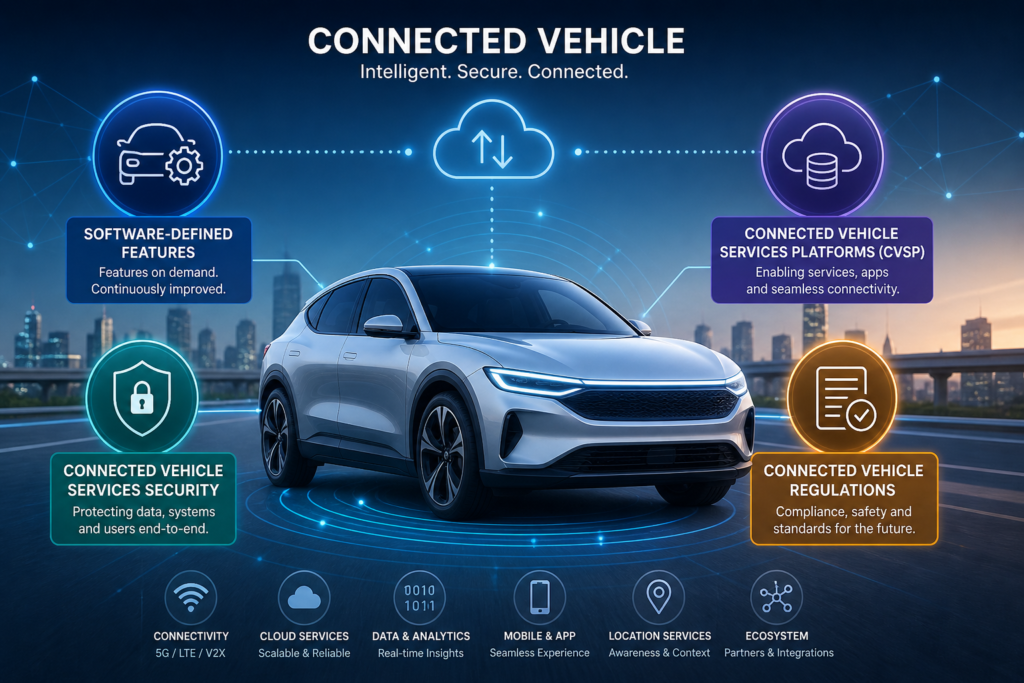
Software-Defined Features: The End of Static Hardware
In a traditional vehicle, features were “baked in” at the factory. In an SDV, the hardware provides the potential, but software unlocks the capability. This decoupling allows OEMs to offer Features on Demand (FoD) and continuous improvements.
- Performance Tuning: EVs can receive Over-the-Air (OTA) updates that optimize battery management systems (BMS), increasing range or improving acceleration without a service visit.
- User Experience (UX): From advanced infotainment and cockpit personalization to ADAS (Advanced Driver Assistance Systems), the “feel” of the car can be rebranded or upgraded seasonally.
- Monetization: SDVs enable recurring revenue models through subscription-based features like heated seats, advanced navigation, or autonomous driving modes.
Connected Vehicle Services Platforms (CVSP)
The “brain” of the modern EV extends beyond the car and into the cloud. A Connected Vehicle Services Platform acts as the orchestration layer between the vehicle’s onboard sensors and external digital ecosystems.
- Cloud Integration: Platforms like AWS Connected Mobility or Microsoft Azure Digital Twins allow OEMs to create a “digital twin” of every vehicle. This enables real-time monitoring of fleet health and predictive maintenance.
- EV-Specific Ecosystems: Connectivity is vital for EV-specific needs, such as real-time charging station availability, energy grid integration (Vehicle-to-Grid/V2G), and intelligent route planning based on current state-of-charge, temperature and elevation.
- Data Monetization: By aggregating vehicle data, businesses can gain insights into driving patterns, battery degradation across climates, and component wear, informing future R&D.
Connected Vehicle Services Security
As vehicles become rolling data centers, the attack surface expands. Security is no longer just about preventing theft; it is about protecting the integrity of the vehicle’s control systems and the privacy of user data.
- End-to-End Encryption: Data moving between the vehicle and the cloud must be secured against interception.
- Vehicle Security Operations Centers (VSOC): Modern EV companies are implementing VSOCs—specialized hubs that monitor fleets for real-time cyber threats and anomalies.
OTA Integrity: The mechanism used to update software is itself a primary target. Ensuring that an update is signed, verified, and hasn’t been tampered with is critical to preventing fleet-wide “bricking” or malicious control.
The Regulatory Landscape: UNECE and Beyond
Innovation in the SDV space is now hitting a wall of global regulation. Compliance is no longer a checkbox; it is a prerequisite for market access.
- UNECE R155 & R156: These landmark regulations mandate that OEMs implement a Cyber Security Management System (CSMS) and a Software Update Management System (SUMS). Without these certifications, vehicles cannot be type-approved in many major markets, including the EU and parts of Asia.
- Data Privacy (GDPR/CCPA): As EVs collect massive amounts of location and behavioral data, they fall under strict privacy laws. Manufacturers must ensure transparency in data collection and provide consumers with “the right to be forgotten.”
- Safety Standards (ISO 26262 & ISO/SAE 21434): These standards define the “Functional Safety” of electronic systems and the “Cybersecurity Engineering” requirements for the entire vehicle lifecycle, from design to decommissioning.
The New Balance Sheet: Financial Implications of the SDV Transition
The shift to software-defined mobility fundamentally alters the financial profile of both the OEM and the fleet operator. While future articles will drill down into specific revenue models, three overarching financial shifts are already reconfiguring the industry’s capital requirements:
- From CAPEX to OPEX: The traditional automotive business model relied on massive upfront Capital Expenditure (CAPEX) with a single point of sale. The SDV model shifts the focus toward ongoing Operating Expenditure (OPEX) to maintain cloud platforms and security operations, balanced by recurring Software-as-a-Service (SaaS) revenue. This transition requires a new approach to valuing a company’s “installed base.”
- The Residual Value Revolution: In a hardware-only world, vehicles are depreciating assets. In an SDV world, OTA updates can potentially stabilize or even increase a vehicle’s residual value. Conversely, “Justification Debt”—the accumulation of unpatched software or unsupported cloud features—can lead to sudden “technical obsolescence,” creating new risks for vehicle financing and leasing portfolios.
- Risk Premium and Compliance Costs: As regulatory requirements (like UNECE R155/R156) become mandatory, the cost of non-compliance isn’t just a fine; it is market exclusion. Finance teams must now account for “Cyber-Resilience” as a core component of the brand’s valuation and insurance premiums.
The Bottom Line
The EV business is no longer about moving parts; it is about managing interpretive custody of data and software. Companies that master the integration of cloud platforms, secure their software supply chains, and navigate the complex regulatory web will define the next decade of mobility. Those that view software as an “add-on” rather than the core architecture will find themselves burdened with “technical debt” they cannot remediate.

About Scott McCormick
Scott McCormick is the President of the Connected Vehicle Trade Association (CVTA). He has over 25 years of leadership and development experience in intelligent transportation systems, connected vehicle technologies, and mobility innovation. Scott has held key roles at organizations including the Automotive Multimedia Interface Collaboration (AMIC) and the VII Consortium. He has advised federal agencies, contributed to global transportation standards, and led public-private initiatives that bridge the automotive, infrastructure, and wireless industries. Scott’s work supports the development of open standards, educational programs, and collaborative networks essential to advancing connected and electric vehicle ecosystems.