
Beyond Subscriptions: How Connected Vehicle Intelligence Is Transforming EV Revenue, Residual Value, Insurance, and Lifecycle Economics
By: Matt Traylen – Principal, Mobilit-IQ
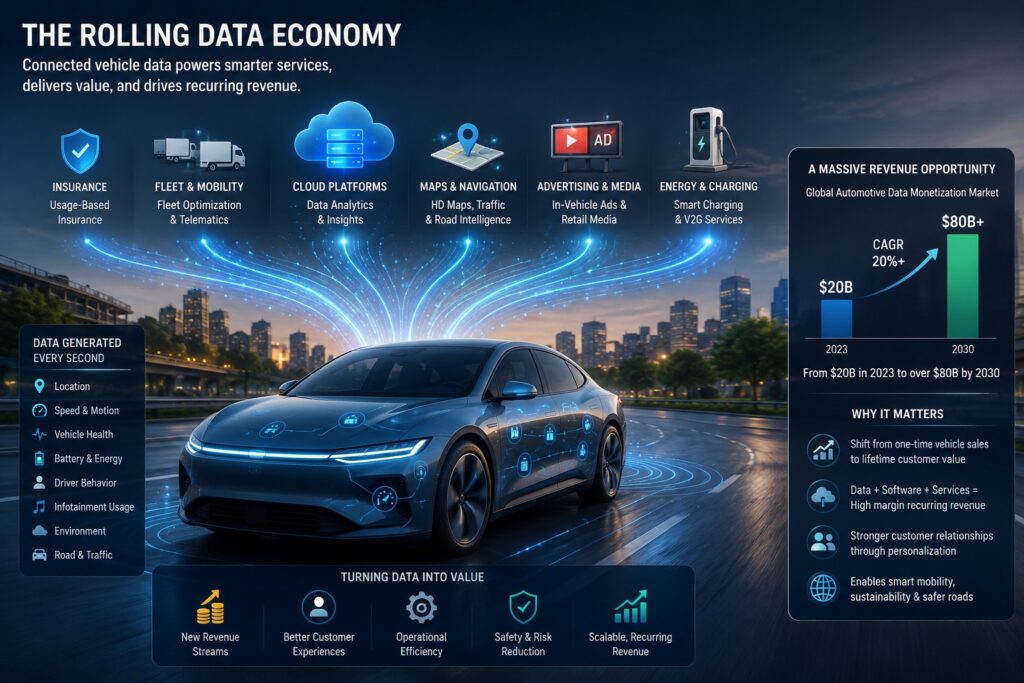
Connected vehicle data is still often framed as a future revenue stream for automakers. That is true, but it misses the bigger strategic point.
The real opportunity is not just selling data, adding another app, or charging a monthly fee for features customers assumed were already part of the vehicle. It is using connected-vehicle intelligence to improve how the industry prices vehicles, manages customer lifetime value, protects residual values, underwrites insurance risk, supports fleet economics, and shapes strategy across the full ownership cycle.
Vehicles are steadily becoming software-defined platforms. They generate data through telematics, diagnostics, infotainment, sensors, cameras, driver-assistance systems, battery management, and cloud-connected applications. The core point is not in dispute. The more important question now is how that data gets packaged, governed, and converted into durable economic value.
How should OEMs, captives, fleets, insurers, and mobility platforms price, package, govern, and monetize connected vehicle data in a way that creates lasting value?
That distinction matters because data collection is not a business model. Monetization only works when there is customer trust, clear consent, a credible value exchange, scalable partnerships, disciplined pricing, and a realistic view of how data affects the vehicle over its full lifecycle.
Earlier McKinsey work pointed to a global connected-car data value pool of up to $750 billion by 2030[i], but its later analysis revised the expected annual incremental value to roughly $250 billion to $400 billion[ii] as adoption and ecosystem development progressed more slowly than first expected. That is the right caution for the market today: the opportunity is still substantial, but not every data stream will command the same value.
The likely winners will not be the companies that collect the most data. They will be the ones that turn data into measurable value for customers, fleets, insurers, lenders, and the used-vehicle market.
The Connected Vehicle Monetization Stack
Connected vehicle data can be organized into several major value layers. Each layer supports different use cases, different customers, and different pricing models.
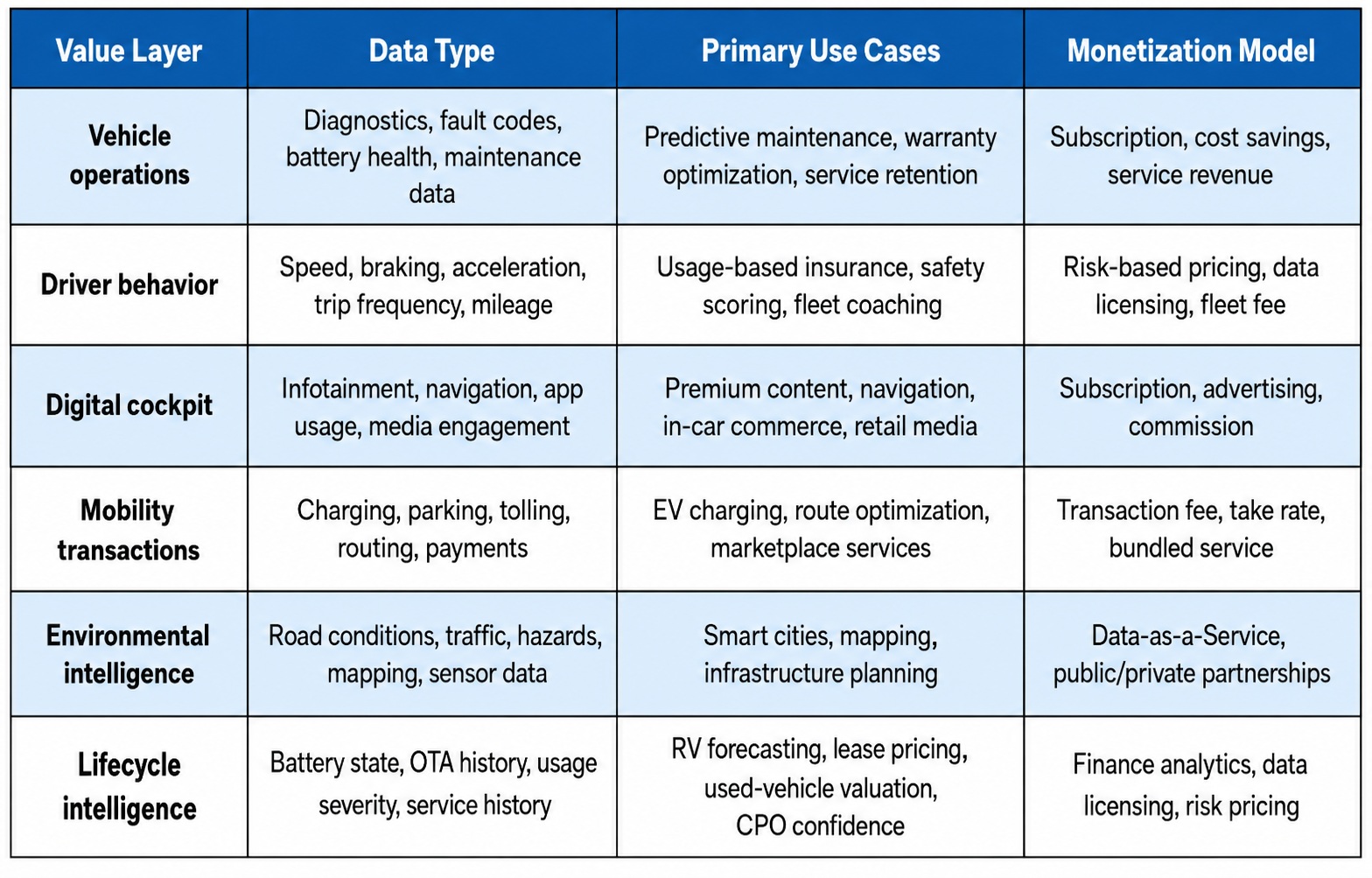
This is where the discussion becomes more commercially useful. Connected vehicle data is not a single business model; it is a portfolio of monetization paths, each with its own customer, value proposition, margin profile, and trust requirement.
A retail customer may push back on paying a monthly fee for a feature they believe was already built into the car. A fleet operator will usually take a different view if the same data reduces downtime, improves safety, lowers energy cost, or raises utilization. Insurers, lenders, and captives will also value the data differently if it improves underwriting, lease pricing, or residual-value forecasting.
In other words, the monetization model has to follow the economic value being created.
Subscriptions Are Important, But They Are Not the Whole Story
Subscription services remain the most visible part of the connected-vehicle story. OEMs have tested recurring fees for remote services, navigation, infotainment, charging tools, enhanced safety functions, and software-enabled upgrades.
The logic is easy to understand. Vehicle sales are transactional. Connected services extend the revenue relationship well beyond the handover date, in some cases for a decade or more. If the offer is credible, lifetime customer value can expand meaningfully.
General Motors has previously outlined a path to roughly $20 billion to $25 billion in software and services revenue by 2030, supported by a connected-vehicle base that was expected to reach around 30 million vehicles[iii]. Stellantis has likewise targeted about €20 billion in annual incremental revenue from software-related services by 2030, with Mobilisights positioned as part of that effort and a connected fleet expected to reach 34 million vehicles[iv][v].
Even so, the industry should be careful about importing SaaS pricing logic too literally into automotive.
With software, customers usually accept subscriptions because the service is continuously updated and clearly delivered on an ongoing basis. In automotive, the customer has already made a large capital purchase. If they believe they already paid for the hardware, a recurring fee can feel less like added value and more like a second invoice.
That creates a simple but important pricing rule:
Customers will pay for connected services when the value feels genuinely incremental, dynamic, and useful. They will resist subscriptions that look like paywalls around hardware already sitting in the vehicle.
This means the better model is not “everything as a subscription.” The better model is a segmented pricing architecture:
- Included safety and trust features
- Bundled convenience tiers
- Premium digital services
- Usage-based fleet and enterprise tools
- Outcome-based products tied to uptime, safety, energy savings, or risk reduction
- Data products where consent, aggregation, and value exchange are clear
The subscription opportunity is real, but subscriptions should be treated as one part of a broader monetization strategy.
Data-as-a-Service May Be More Durable Than Consumer Feature Fees
Consumer subscriptions attract the headlines, but the more durable economics may sit in Data-as-a-Service and enterprise connected-vehicle products.
The reason is straightforward: business customers can often quantify the ROI.
That is mainly because business customers can usually quantify the return. Fleet operators care about uptime, total cost of ownership, route efficiency, driver safety, energy use, utilization, and maintenance planning. Insurers care about risk segmentation and claims performance. Infrastructure and mapping providers care about congestion, hazards, and road-condition data. Captive finance companies care about collateral quality, usage patterns, and remarketing outcomes.
In these cases, connected vehicle data is not a novelty. It is an economic input.
Mobilisights, the Stellantis data business launched in 2023, is a useful example. It was set up to license connected-vehicle data for B2B applications spanning operational efficiency, safety, usage-based insurance, and traffic-management use cases, all under a stated framework of data governance and consent.
That is where the strongest monetization case may emerge: not from asking consumers to pay small fees for isolated features, but from helping commercial customers make better operating and risk decisions.
That distinction matters because enterprise and fleet monetization can be priced around measurable value:
- Reduced downtime
- Lower maintenance cost
- Improved routing
- Fewer accidents
- Better vehicle utilization
- Lower insurance losses
- More accurate energy planning
- Improved remarketing outcomes
This is closer to value-based pricing than traditional automotive option pricing.
The Overlooked Link: Connected Data and Residual Value
One of the least developed, and potentially most valuable, applications of connected-vehicle data is residual-value management.
Residual-value forecasting has traditionally relied on brand strength, depreciation patterns, mileage, segment performance, incentives, used supply, product competitiveness, macro conditions, and remarketing trends. Those variables still matter. What connected data adds is a new layer of asset-level intelligence.
Future used-vehicle buyers, lenders, captives, insurers, dealers, and guidebook providers may increasingly care about:
- Battery health
- Charging behavior
- OTA update history
- Software eligibility
- ADAS functionality
- Diagnostic history
- Usage severity
- Maintenance compliance
- Feature transferability
- Repair and fault-code history
- Warranty exposure
- Fleet versus personal-use patterns
This is especially important for EVs.
That is especially relevant in EVs. Two used EVs with the same age, mileage, trim, and cosmetic condition may not carry the same economic value if one shows stronger battery health, better charging behavior, a cleaner diagnostic record, and better OTA support. In that context, connected data becomes part of the vehicle’s value narrative, not just a technical appendix.
For OEMs and captives, this has major implications. Connected data can support better lease pricing, more accurate residual value setting, stronger certified pre-owned programs, improved warranty forecasting, and more confident remarketing.
It also creates new risks. OTA updates can improve the value of current vehicles, but they can also accelerate obsolescence for older vehicles that cannot receive the same features. Subscription transferability may influence used-vehicle desirability. Battery transparency may improve confidence for strong vehicles, while exposing weaker ones to faster depreciation.
That is why connected vehicle data should not be viewed only as a revenue stream. It should also be viewed as a lifecycle value-management tool.
The strategic question is not only:
How do we sell the data?
It is also:
How do we use the data to protect the value of the vehicle, improve customer trust, reduce risk, and optimize the full lifecycle economics of the product?

About Matt Traylen
Matt Traylen is an expert in automotive finance, pricing, lifecycle and mobility strategy, focusing on the business models shaping the next generation of automotive and EV markets. His work centers on how OEMs, captives, fleets, and mobility companies can create more sustainable value through lifecycle strategy, smarter pricing architecture, connected vehicle data, and recurring revenue models. With more than 20 years of experience across automotive finance, EV market strategy, residual value forecasting, and mobility business model development, Matt brings a practical perspective on how vehicle economics are changing as the industry shifts from one-time vehicle sales toward software-enabled services, data-driven decisioning, and full-lifecycle monetization.