

By: Dr. Partha Goswami – CEO of PG Mobility Anaysis
Software-defined vehicles (SDVs) are transforming automobiles into continuously evolving digital platforms that can rapidly deliver new services, software features, and recurring revenue opportunities for OEMs and mobility providers. A modern SDV is a complex system that can contain well over 100 million lines of code (LOC) —far more than the approximately 6.5 million LOC in a Boeing 787. Developing connected services on this platform involves integration of multiple ECUs, high-speed data network, cloud platforms, billing systems, and third-party services while addressing a slew of interoperability, onboarding, and standardization challenges.
How do SDVs Differ from Traditional Vehicles?
Three characteristics separate SDVs from traditional vehicles. First, core vehicle systems (e.g., ADAS, infotainment, propulsion, battery management, chassis) are increasingly managed through software rather than standalone hardware modules. Second, SDVs maintain persistent cloud connectivity through embedded telematics systems and cellular networks. This enables remote diagnostics, data collection, OTA software updates, and cloud-driven service delivery. Third, unlike traditional vehicles that remain mostly unchanged after purchase, SDVs improve over time through software updates and new service activation. This architectural shift allows OEMs to maintain an ongoing digital relationship with customers throughout the vehicle lifecycle.
The Rise of Software-Defined Vehicle Services
The automotive industry is shifting from a mechanical product business into a software-centric product and services business, offering personalized services, safety enhancements, and new digital experiences long after the vehicle leaves the dealership. Software-defined vehicles (SDVs) are at the center of this transformation. Unlike traditional vehicles, where features are primarily fixed at the time of manufacturing, SDVs allow manufacturers to add, modify, and improve post-sales features and services.
This shift is enabling automotive OEMs, mobility providers, technology companies, and cloud platform developers to create recurring revenue opportunities. These services can include one-time feature-on-demand or recurring subscription-based, AI-powered convenience features, streaming media, gaming options, new advanced driver assistance systems (ADAS), personalized interior functions, usage-based insurance, predictive maintenance, and optimized fleet operations.

You want to discover more about Connected Vehicle Services Development for SDVs? Listen to the podcast session that this article summarizes – EVBusiness.net/118. Also available on Spotify, Pandora, Audible, iHeartRadio & other podcast networks.
What Is SDV Services Development?
SDV services development focuses on creating new post-sale customer experiences and recurring revenue opportunities for OEMs and ecosystem partners. Developing these services involves designing, integrating, deploying, managing, and monetizing digital services that operate across the connected vehicle ecosystem. These services are typically created by leveraging vehicle data and APIs, telematics platforms, cloud computing systems, AI analytics, billing systems, third-party content, and security systems.
One of the largest categories of SDV services is personalization. Vehicles can automatically and through natural voice commands adjust settings based on driver profiles, habits, preferences, or driving patterns. This may include seat positioning, climate control, navigation preferences, and entertainment recommendations. Another important category is feature-on-demand services, where manufacturers can activate or unlock features after vehicle purchase. Examples include hands-free driving systems, enhanced ADAS capabilities, performance upgrades, heated seats, premium audio systems, and enhanced battery range.
Streaming content such as media and gaming is also becoming a major category of connected services. SDVs increasingly support audio/video streaming, interactive entertainment, cloud-based rear-seat gaming, and in-vehicle advertising. Gaming is an interesting niche but particularly attractive category, given that the gaming industry now exceeds Hollywood in overall market size, and gamers include a broad age demographic. Other key service areas include usage-based insurance, predictive maintenance, and myriad fleet services, including route optimization, driver authentication, energy management, and predictive safety systems that identify potholes, road hazards, black ice conditions, or dangerous driving environments by analyzing sensor data collected from the vehicle fleets.
The Architecture for Connected Services Development
Architecting connected vehicle services requires a highly integrated end-to-end platform, incorporating high-speed in-vehicle networking capable of moving large amounts of data between sensors, ECUs, compute systems, and infotainment platforms. Ethernet-based networks are increasingly replacing older CAN bus systems in traditional vehicles.
Traditional vehicles are usually architected with dozens or hundreds of separate ECUs, with embedded software. SDVs increasingly use centralized compute platforms capable of handling multiple vehicle functions simultaneously, run by software updatable over the air, enabled by built-in cellular connectivity, cloud communications, that can remotely diagnose and monitor vehicle systems. Modern telematics systems increasingly rely on 5G connectivity for higher bandwidth and lower latency communications.
Cloud infrastructure is critical for the new services since it enables remote AI-powered analytics, the use of digital twins, service orchestration, billing management, and fast validation of new services. Major cloud providers include Amazon Web Services, Microsoft Azure, and Google Cloud. OEMs and third-party developers increasingly use these cloud environments in their app factory environments to rapidly create, test, validate, and deploy connected vehicle applications.
Key Challenges in Connected Services Development
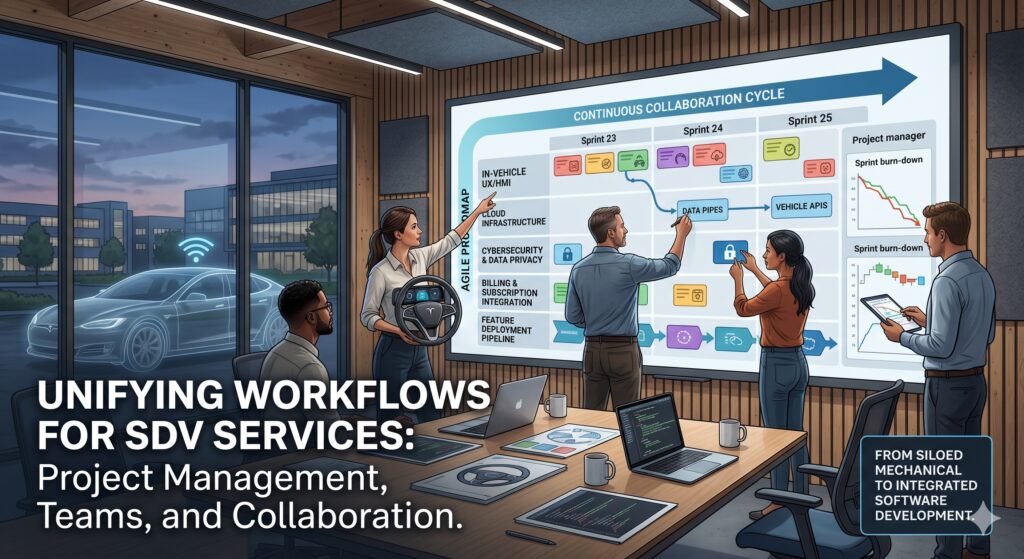
One of the biggest challenges facing the automotive industry is that traditional automotive development processes were built around mechanical engineering and siloed teams. Developing the SDV platform and digital services requires software-first thinking and highly collaborative cross-functional development. This transition is difficult for many established OEMs because mechanical and software teams within their organization often operate independently. The organizational culture resists rapid iteration, and the corresponding development cycles are slow. Additionally, the suppliers were historically managed through rigid specifications – a process that was not designed for rapid change management.
Developing an SDV and its post-sales services framework also requires continuous collaboration between OEM software teams, Tier 1 suppliers, cloud providers, app developers, AI companies, security firms, and data analytics providers. This concurrent collaboration model, in which all stakeholders participate throughout the development process, is replacing the traditional paradigm of specification-based static development.
Another major challenge is data standardization. Third-party developers require standardized access to vehicle data. Without common data models and APIs, developers must customize services separately for each OEM platform. Industry groups such as COVESA and AUTOSAR are helping standardize automotive software architectures and data exchange models.
OTA updates also create enormous validation challenges. A faulty software patch can rapidly impact millions of vehicles simultaneously. The readers may well remember the example of CrowdStrike, where a defective software patch in 2025 disrupted millions of systems globally. Automotive OTA systems, therefore, require extensive simulation, testing, security analysis, and continuous monitoring.
Finally, cybersecurity remains a major challenge because connected vehicles dramatically expand the attack surface for cyber threats, creating vulnerabilities for everything from vehicle controls, driver privacy, cloud platforms, payment systems, and OTA delivery. Cybersecurity must therefore be built into SDV architectures from the beginning rather than added later.
On the consumer side, “subscription fatigue” is also becoming a serious and relevant issue. Consumers increasingly resist paying subscription fees for features they believe should already be included with the vehicle purchase. Early examples, such as BMW’s heated-seat subscriptions, created backlash because customers viewed those features as fundamental vehicle functions rather than premium add-ons. Successful SDV services must therefore provide clear post-sales value, novel experiences, measurable operational benefits, and convenience improvements, such as time savings or safety enhancements.
SDV Services Development Implementation Guide
The first step in implementing successful SDV services is building the right vehicle architecture. OEMs must begin with scalable software-defined architectures capable of supporting high-speed networking, centralized computing, OTA updates, cloud integration, and service-oriented design. Without this foundation, services become difficult to scale or evolve.
The second step is creating cross-functional development teams. SDV services require collaboration across multiple vehicle engineering disciplines, including cloud engineering, security, UX design, data science, AI development, mobile applications, billing systems, and legal and compliance teams. Traditional linear and siloed development models are no longer effective.
The third step involves implementing standardized data models. Standardized APIs and data structures are key to interoperability and reducing development complexity for ecosystem partners.
The fourth step is to ensure an end-to-end digital framework that leverages cloud-based enablers such as digital twins. Digital twins allow OEMs to simulate services, validate behavior, test new functions, and optimize experiences before deployment.
Scalability remains a critical requirement. A scalable OTA infrastructure supports fast deployment across a broad portfolio, ensuring secure delivery and real-time monitoring. At the same time, OEMs must understand and focus on what constitutes the right consumer value. Successful services must solve meaningful customer problems rather than simply adding novelty features. Examples of strong consumer value include reduced driving fatigue, improved safety, time savings, fleet efficiency, energy optimization, and personalization that truly augment the driving and ownership experiences.
Finally, companies must design frictionless onboarding processes. Consumers expect simple activation, billing, and service management experiences. Complex onboarding processes reduce adoption rates and negatively impact customer satisfaction.
The Future of SDV Services Development
The automotive industry is still in the early stages of software-defined transformation. Many OEMs initially overestimated the speed and scale of connected services monetization opportunities. However, the long-term opportunity remains enormous as vehicles increasingly become AI-enabled digital platforms, personalized mobility environments, connected commerce systems, entertainment hubs, and energy management nodes.
Successful future SDV services will likely combine AI-powered personalization, context-aware experiences, autonomous mobility systems, real-time environmental analytics, vehicle-to-grid energy management, advanced fleet automation, and immersive media services. OEMs that effectively combine scalable architectures, cloud ecosystems, consumer value, security, and operational excellence will be positioned to dominate the next generation of automotive digital services.

About Dr. Partha Goswami
Dr. Partha Goswami is a connected vehicle and software-defined vehicle (SDV) strategist and technology leader with extensive experience in automotive software platforms, mobility ecosystems, and connected services development. He has over 20 years of leadership and development experience with software-defined vehicles, connected mobility platforms, automotive cloud services, and digital transformation strategies. Partha Goswami has worked with automotive OEMs, mobility technology companies, and industry organizations focused on SDV architecture, AI-driven vehicle platforms, and connected services ecosystems.