
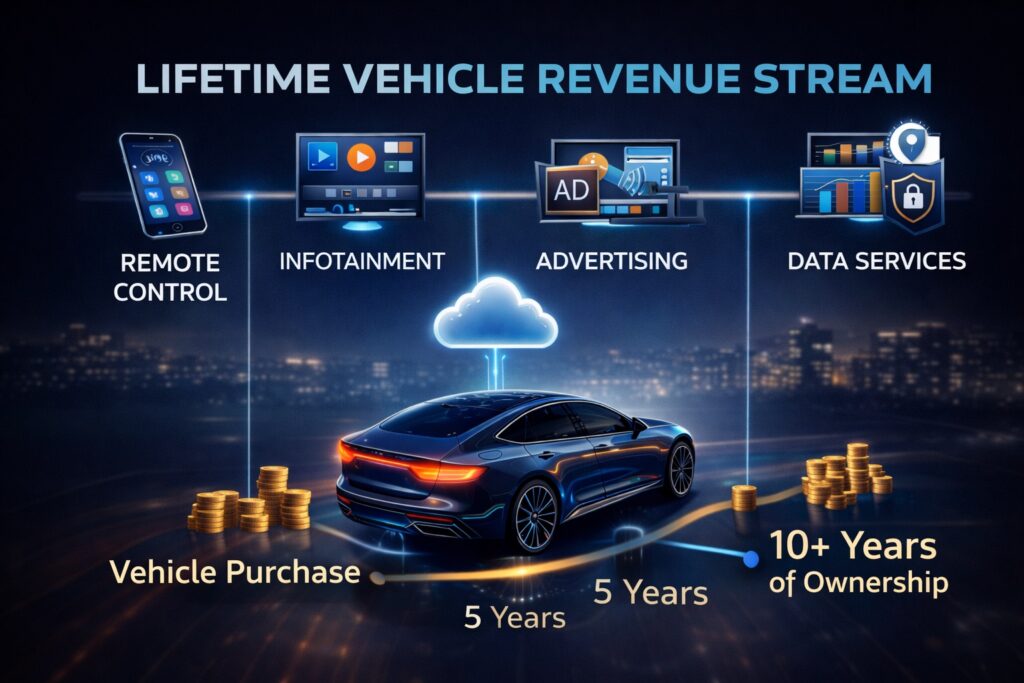
New Revenues for Automotive OEMs that Last for the Life of the Vehicle
By: Lawrence Harte
Automotive OEM businesses are rapidly shifting from one-time vehicle sales toward connected digital services that can generate high-profit recurring revenues throughout the entire lifecycle of connected vehicles. Vehicle manufacturers typically earn only 4% to 10% profit margins from vehicle manufacturing, while digital services can generate margins approaching 70%. GM predicts that by 2030 it could earn more revenue from digital services than from vehicle manufacturing itself. However, OEMs, platform providers, and automotive technology companies face major challenges including rapidly expanding feature and service options, unclear monetization models, and the difficulty of getting vehicle owners and occupants to actively use and pay for connected services. Listen to this podcast session to discover the key types of connected vehicle services, surprising new revenue opportunities, and the emerging software-defined vehicle trends that are transforming automotive platforms into long-term high-profit digital service ecosystems.
This transformation is creating a business opportunity similar to the rise of the commercial Internet in the 1990s. Automotive OEMs now operate as digital platform providers because nearly all vehicle communication flows through OEM-controlled cloud systems. These systems manage infotainment, remote diagnostics, navigation, software updates, advertising platforms, connected apps, and driver personalization services. As a result, OEMs increasingly function as digital gatekeepers that can monetize vehicle relationships long after the initial vehicle purchase.
Owners of connected vehicles typically receive many communication, navigation, safety, and remote-control services at no additional cost during an introductory trial period that usually lasts between three and five years. After the trial expires, users must subscribe to continue receiving premium connected services. Industry studies indicate that more than 40% of vehicle owners convert from free trial users into paying connected service customers. This recurring revenue model is encouraging OEMs to expand digital ecosystems that generate income for the entire operational life of the vehicle.
This article examines the major business models driving the connected vehicle services industry, including paid features, subscription services, in-vehicle advertising, and vehicle data monetization.

You want to discover more about Connected Vehicle Services Business? Listen to the podcast session that this article summarizes – EVBusiness.net/119. Also available on Spotify, Pandora, Audible, iHeartRadio & other podcast networks.
Paid Features
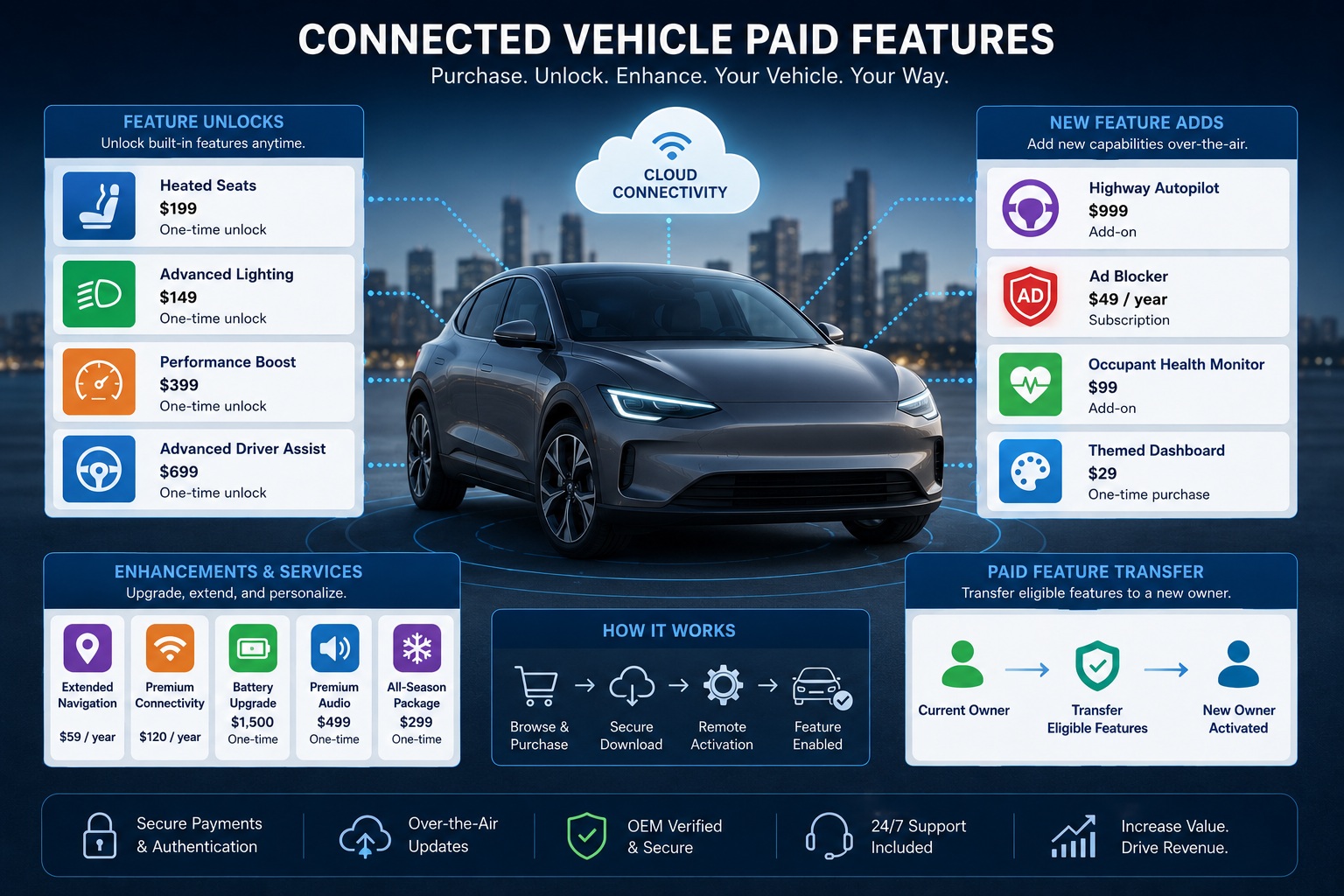
Connected Vehicle Paid Features
Connected vehicle paid features allow automotive manufacturers to remotely activate, disable, or upgrade software-controlled vehicle capabilities using cloud connectivity and over-the-air updates. Instead of requiring physical hardware upgrades, many vehicle capabilities are now enabled digitally through software authorization systems.
Examples of remotely activated features include heated seats, premium lighting systems, advanced acceleration modes, autonomous driving capabilities, enhanced navigation, vehicle monitoring systems, and commercial vehicle services. Some OEMs are also introducing entirely new software modules that add capabilities after the vehicle has been purchased. These additions can include self-driving upgrades, occupant health monitoring, advanced cybersecurity services, advertising blockers, themed dashboard interfaces, and productivity applications.
One emerging opportunity is paid feature transferability. Certain connected features may remain attached to the vehicle when ownership changes, increasing the resale value of the vehicle and creating new secondary market revenue opportunities for OEMs and dealers.
However, OEMs must carefully balance monetization strategies with customer expectations. Some consumers have reacted negatively to subscription-style pricing for features they believe should already be included in the vehicle purchase price. Long-term success will depend on pricing fairness, transparency, customer value, and the ability to continuously improve features through software updates.
Subscription Services
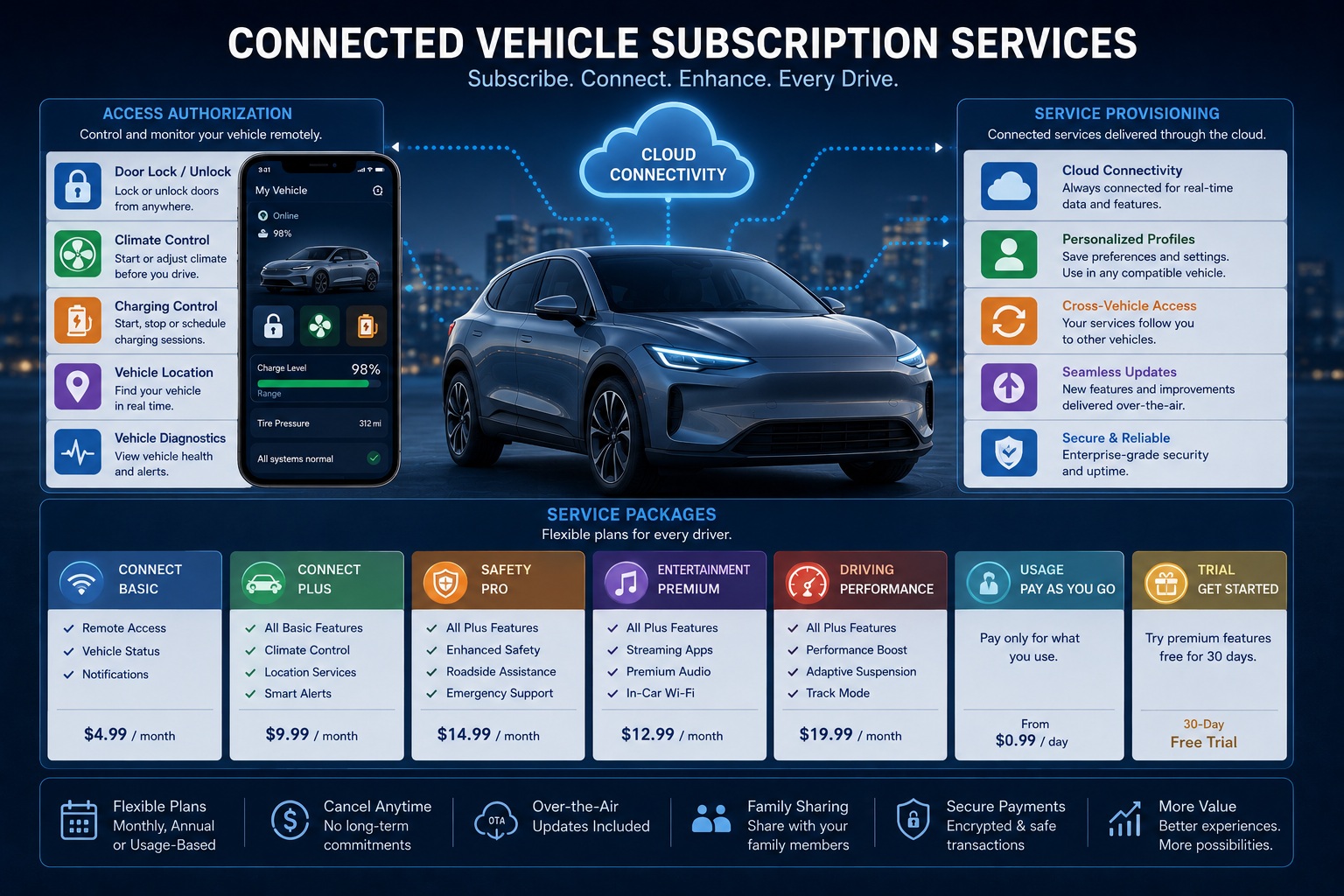
Connected Vehicle Subscription Services
Connected vehicle subscription services are becoming one of the most important recurring revenue opportunities for automotive manufacturers. These services provide ongoing access to digital features, cloud-based applications, safety services, infotainment systems, remote vehicle management tools, and personalized driver experiences.
Connected mobile applications allow vehicle owners to remotely monitor and control many vehicle functions, including charging systems, climate control, door locks, vehicle location tracking, and diagnostic reporting. Some services are cloud-profile based, allowing users to access personalized settings and applications across multiple vehicles.
OEMs increasingly package services into flexible monthly, annual, usage-based, and trial subscription plans. Subscription ecosystems are expanding beyond vehicle management to include charging services, media streaming, navigation, commerce applications, insurance programs, productivity services, and mobility platforms.
These recurring subscription ecosystems improve customer retention while creating long-term digital relationships between vehicle owners and automotive brands. For OEMs, connected subscriptions transform the vehicle from a one-time transaction into an ongoing service platform capable of generating revenue for years after the initial sale.
In-Vehicle Advertising
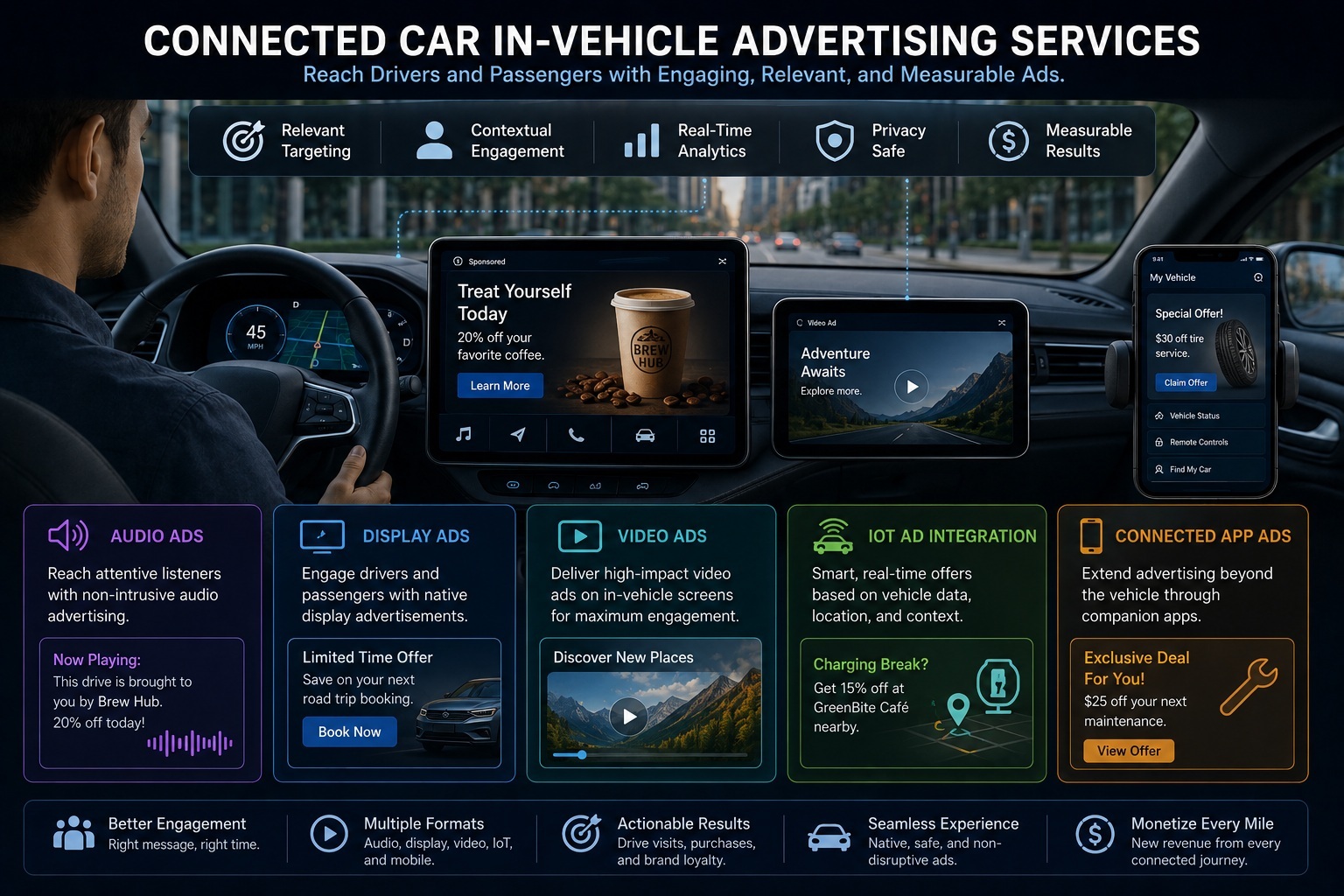
Connected Car In-Vehicle Advertising Services
Connected vehicle advertising is emerging as a major new media platform for automotive OEMs, advertisers, streaming providers, and mobility companies. Connected vehicles can deliver targeted advertising directly through infotainment systems, connected apps, digital displays, audio systems, rear-seat entertainment platforms, and voice assistants.
Advertising formats inside connected vehicles include audio ads, display ads, streaming video ads, interactive advertising, IoT-enhanced advertising, and companion app promotions. Unlike traditional automotive advertising, connected vehicle platforms allow highly personalized targeting based on location, vehicle type, driver profile, charging status, trip destination, driving behavior, and contextual conditions.
Sponsored services are becoming another important business model. Charging providers, navigation companies, retailers, restaurants, entertainment providers, and advertisers can subsidize connected services through sponsorship agreements and targeted promotions. This creates opportunities for OEMs to offset service delivery costs while improving customer engagement.
Despite the revenue opportunity, in-vehicle advertising introduces important privacy and safety challenges. Automotive companies must carefully manage driver distraction, cybersecurity protection, user consent, data governance, and regulatory compliance. Successful in-vehicle advertising systems must balance monetization opportunities with safe and non-intrusive user experiences.
Data Monetization
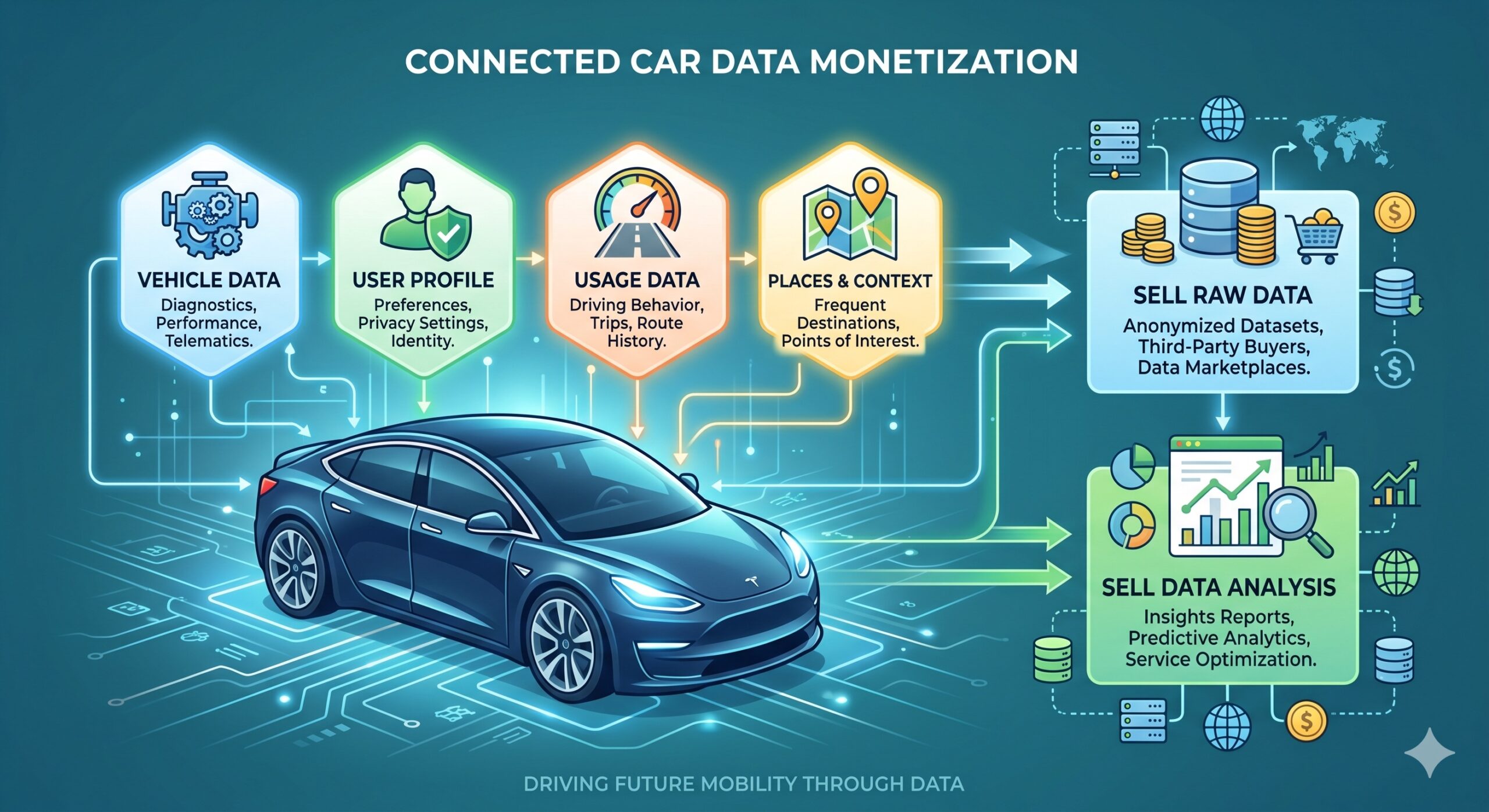
Connected Vehicle Data Monetization
Connected vehicles continuously generate massive amounts of operational and behavioral data that can be monetized through analytics, digital services, subscriptions, insurance programs, partnerships, and advertising ecosystems. Vehicle telemetry systems collect information related to location, speed, battery performance, diagnostics, charging activity, infotainment usage, and component health.
Connected vehicle platforms also collect user-related information such as media preferences, infotainment engagement, application usage, and driving behavior patterns. When aggregated and anonymized, this information can create significant commercial value for traffic analysis, predictive maintenance, mobility optimization, fleet management, and smart city planning.
Automotive OEMs are increasingly exploring vehicle data marketplaces where anonymized vehicle insights can be licensed to insurers, municipalities, mapping providers, retailers, infrastructure operators, and mobility service providers. These partnerships can create entirely new digital revenue streams that extend far beyond traditional vehicle manufacturing.
However, data monetization strategies must comply with privacy regulations, cybersecurity standards, consent management policies, and emerging data governance frameworks. Consumer trust will become one of the most valuable assets in the connected vehicle economy.
The Future of Connected Vehicle Services
Connected vehicles are transforming the automotive industry into a recurring digital services business. As vehicles become increasingly software-defined, cloud-connected, and media-enabled, automotive OEMs are evolving into digital platform operators that manage communications, services, commerce, and data ecosystems throughout the life of the vehicle.
Future growth opportunities will likely include autonomous driving subscriptions, AI-powered vehicle assistants, connected commerce, immersive entertainment platforms, predictive maintenance services, advanced mobility ecosystems, and vehicle-based advertising networks. The companies that successfully balance monetization, privacy, customer value, and continuous innovation will be positioned to lead the next generation of the automotive industry.

About Lawrence Harte
Lawrence Harte is the publisher and senior editor of EV Business Magazine and the Director of Automotive Media and Digital Services at the Connected Vehicle Trade Association – CVTA. He has authored more than 153 books – mostly on communications, media, automotive and business. Between 2005 and 2026, he interviewed more than 4,137 executives and technologists in the communication, media and automotive industries. He is the author of Connected EVs Explained, EV Charging Systems for Apartments and Connected Vehicle Services Business books. Mr. Harte has worked for Ericsson/General Electric, Audiovox/Toshiba and has been an expert consultant for Samsung, Google TV , Nokia, and dozens of other top media and technology companies. At Ericsson GE, he was responsible for the development of mobile phone radio modules and worked with Ford, Delphi and other companies to help integrate cellular modems – telematics – into vehicles and systems. He holds many degrees and certificates including an Executive MBA from Wake Forest University, and a BSET from the University of the State of New York.
Website: EV Business Magazine